Geometry you can feel, not just see
Proportion in traditional Islamic design, and what it offers a modern building.
Ali Siddique
Most people meet Islamic geometry as pattern: the star and the polygon, the tiled wall, the carved screen. It is beautiful, and easy to borrow. But the more time I spend with traditional Islamic architecture, the more I think the pattern is the least important part. What matters is the geometry underneath, the proportions and the order, which you feel as you move through a space long before you notice any decoration.
Order before ornament
A traditional courtyard house, a madrasa or a garden is usually set out on a simple frame. A square, divided and divided again. A centre, and four directions running out from it. Rooms and openings placed on that frame so that everything relates to everything else. The result is a kind of calm. You may not be able to say why a space feels settled and right, but very often it is because its proportions are doing quiet work.
That is the part I find most useful as an architect. Pattern can be applied to almost anything. Proportion has to be designed in from the start.
Learning to look
I first started paying attention to this properly in India, where I saw traditional buildings that had clearly been set out with enormous care: courtyards whose proportions felt exactly right, gateways placed so that you saw just enough of what lay beyond, sequences of spaces that slowed you down and then opened up. None of them depended on pattern. Plenty of them had almost none. What they shared was a disciplined underlying order.
Since then I have tried to read buildings that way, wherever I am. Where is the centre? What is the basic module? How do the openings relate to the walls around them? What happens when you move from one space to the next? Ask those questions of a good mosque, a good college quad or a good Georgian square and you start to see how much work the geometry is quietly doing.
A small example
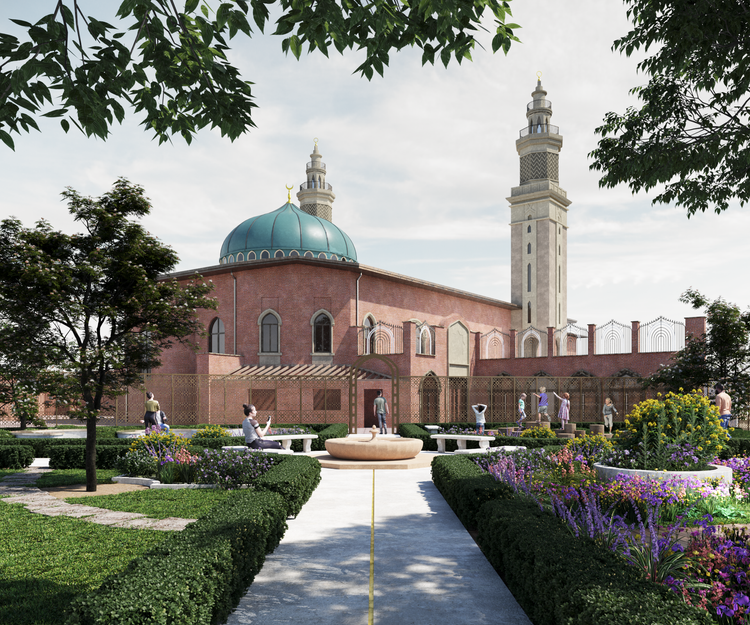
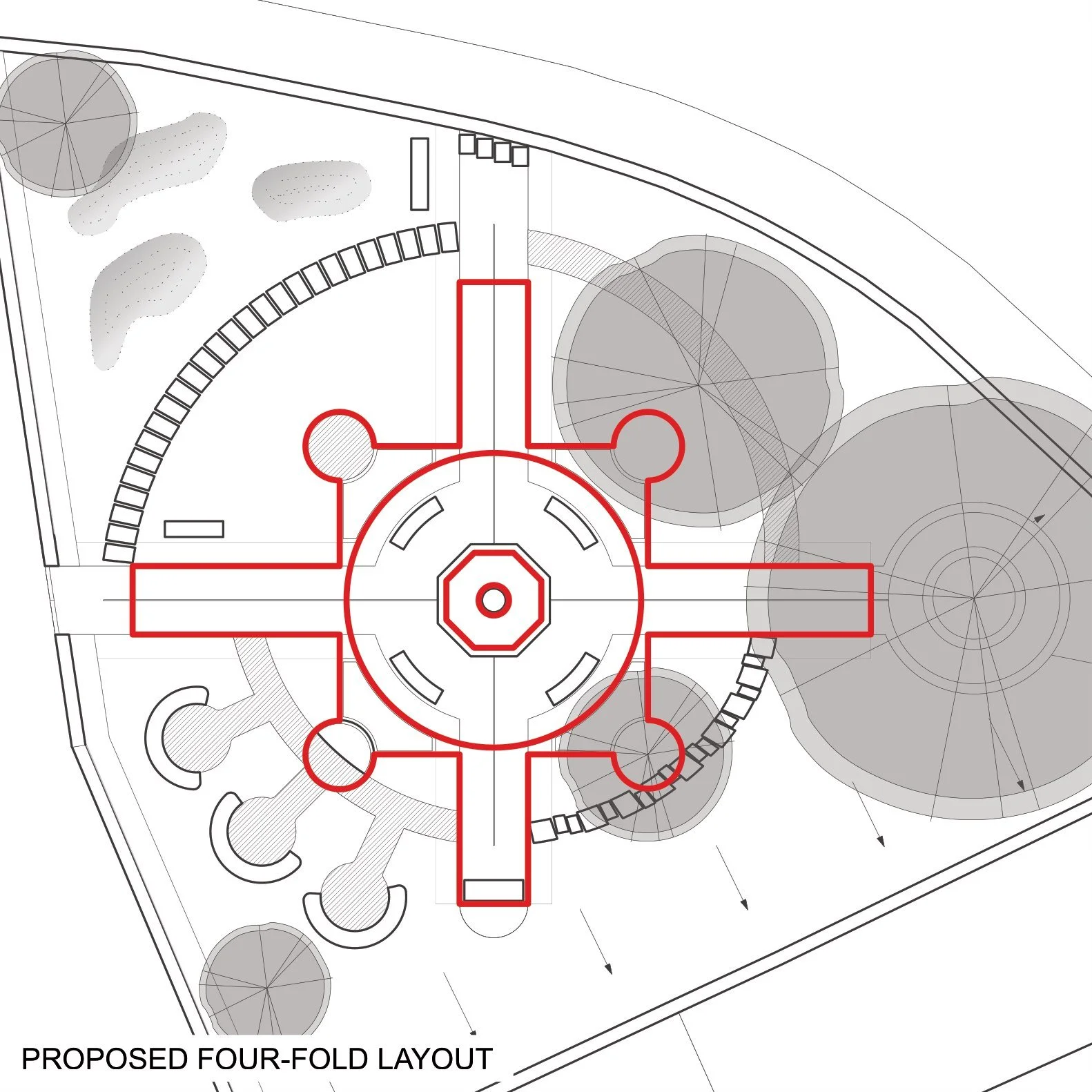
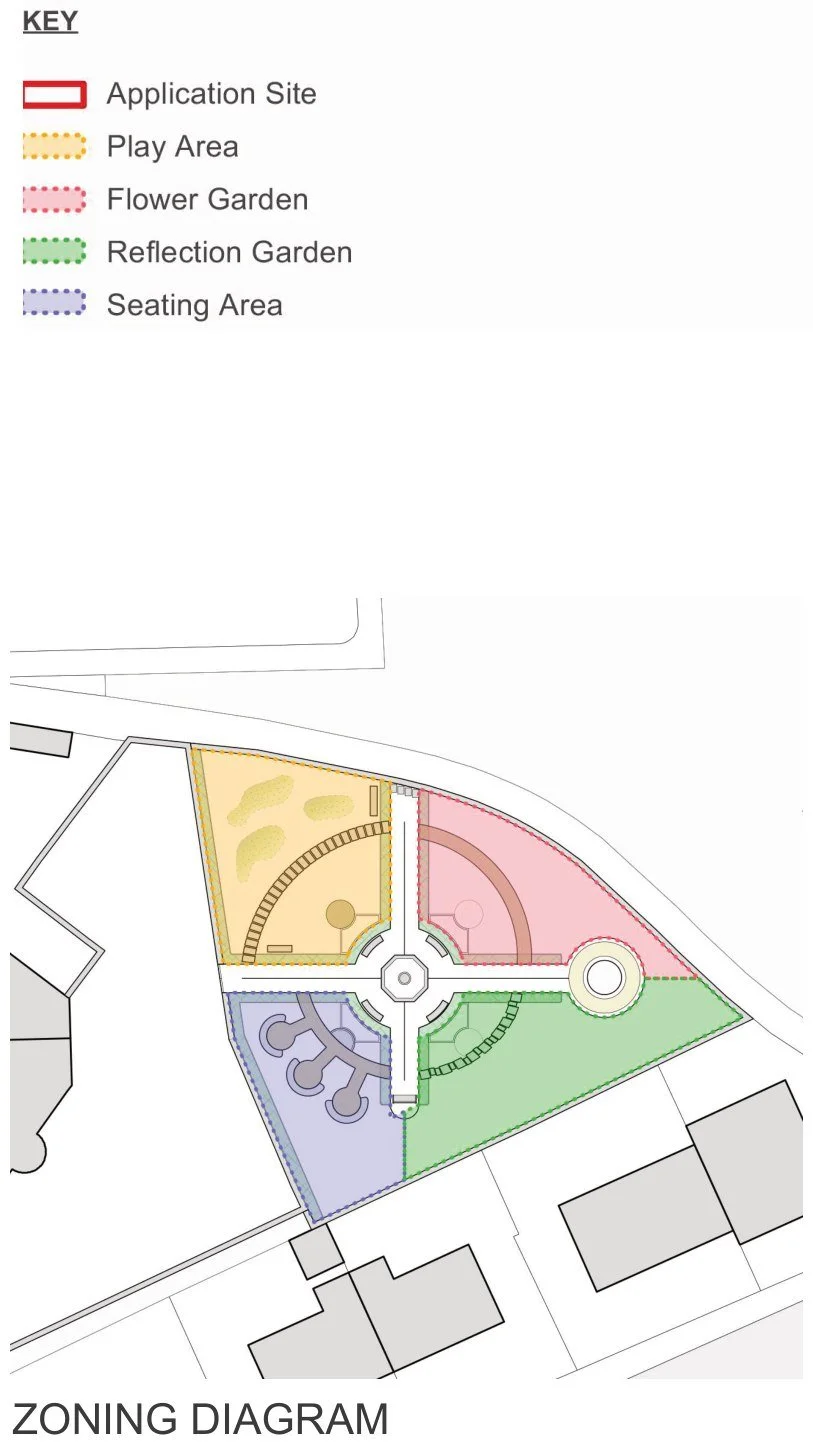
On Bilal Gardens, a small garden we designed beside Bilal Mosque, the starting point was the chahar-bagh, the Persian four-fold garden: four paths meeting at a fountain, dividing the ground into four parts. The site itself was an irregular, leftover shape. Rather than force the whole thing into a perfect square, we let the centre be strict and the edges loose. The fountain and the cross of paths hold the order; the planting and the boundaries follow the land.
I like that balance. It is how a lot of traditional cities work too: a clear, ordered core within an organic surrounding. The geometry gives you something to hold on to. The irregularity lets the building or garden belong to its particular place.
What it offers now
I do not think modern buildings need to look Islamic to learn from this. The lessons are more general. Set out a building on a clear frame and let the important spaces sit on it. Think about the sequence of arrival, from street to threshold to room. Use repetition, and then break it once, deliberately, where something important happens. Make the centre of a space feel like a centre.
Geometry and use
It is worth saying that good geometry is not only about beauty. It is also very practical. A clear frame makes a building easier to plan, easier to build and easier to adapt later. Repeated bays can be fitted out in different ways over time. A strong centre gives people somewhere to orient themselves. A disciplined grid of openings makes a facade cheaper to construct and calmer to look at.
The traditional builders who set out courtyards and gardens on simple squares were solving practical problems as much as aesthetic ones. They wanted shade, privacy, water and good air, and they found that a clear, ordered plan gave them all four. The beauty came, in a sense, as a by-product of doing the job well.
These are old ideas, and not only Islamic ones. You can find them in Georgian terraces and in Oxford and Cambridge colleges. But Islamic architecture has thought about them with unusual seriousness, and with a sense that order in a building can reflect a larger order, and help the people inside it feel more at rest.
That, to me, is geometry you can feel. Not a pattern on the wall, but a building that makes sense as you walk through it.
Related projectsBilal Gardens